The Stories Behind Downtown Marion’s Historic Landmarks
- Chip Gregory
- Mar 20
- 4 min read

Downtown Marion isn’t just a collection of buildings—it’s a record of how this community was built, one storefront, office, and gathering place at a time. Long before it became a destination for shopping, dining, and events, these streets were the operational core of a growing city—supporting industry, shaping local culture, and defining daily life. Flashback Friday takes a closer look at the structures that still stand today, not as relics, but as active pieces of Marion’s identity.
The effort to preserve downtown Marion’s historic character did not happen by accident. In 2019, Downtown Marion, Inc. launched a focused initiative to document and protect the structures that define the city’s core. The goal was not simply to acknowledge that these buildings existed, but to formally record their significance and ensure their place in Marion’s future.
Preservation at this scale does not happen through one organization alone. It requires funding, research, and a shared commitment to documenting what matters before it is lost.
Key contributors played a critical role in moving this effort from idea to outcome.
Support from the Marion Community Foundation provided the financial backing needed to carry out the documentation and nomination process. At the same time, the work of Randy Winland brought the necessary historical depth—grounding each building in accurate records, context, and narrative.
This combination of local funding and detailed research is what made the designation possible. It also reinforces a larger point: preservation is not automatic. It is a coordinated, community-driven effort that depends on people who are willing to invest time, resources, and expertise into protecting the city’s history in a meaningful, lasting way.
Landmark Spotlights

The Uhler Building
At the northwest corner of Prospect and Center streets is the 1902–03 Huber Building. This large five-story office building is of the Second Renaissance Revival style. It has a stone base at the first floor, which includes a cornice and emphasized entrances with quoins and segmentally arched openings. Upper stories are brick and the quoin pattern is continued, although it is created with alternating sections of raised brick instead of stone. This building was home to the Uhler Phillips Department Store, later to be Uhler’s. This building was constructed by the famed industrialist, Edward Huber.

Old Stone Block
Nathan Peters, Marion’s first mayor, is credited with erecting the building at 127 South Main Street around 1830, less than ten years after the city of Marion was platted in 1822. Early occupancy records for what became known as the Old Stone Block building are difficult to ascertain with any certainty. One of the first on record was in 1844 for the George Miller & Sons Dry Goods Store. The Buckeye Eagle newspaper was then located on the second floor. From the time of its opening, the building’s three ground-level storefronts housed multiple tenants, including residential.

Masonic Temple
The Masonic Temple building was commissioned in 1900 and completed in 1903. This Marion landmark is the permanent home of the Marion Masonic fraternity. The Marion Masonic Lodge #70 F&AM traces its roots back to its formation in 1840. This structure, constructed in the Second Renaissance Revival style, was placed on the National Register of Historic Places in 2022.

The Opera House
The three-story Grand Opera House, at 130–136 South State Street, was completed in 1896. In 1914, a three-story addition was built on the south elevation. Although the addition is of a different style and appears to be a separate building, the two sections originally had interior connections on the second and third floors. The Elks club occupied the upper floors of both building sections from 1885 to 2022. The Grand Opera House, later the Grand Theatre and then the Ohio Theatre, is Second Renaissance Revival in style, while the 1914 brick addition is Neo-Classical Revival in style, featuring fanlights, keystones, arched storefront openings, and decorative shield carvings.

Montgomery Ward
The Montgomery Ward Co. department store, at 205 West Center Street, is a 2½ story brick building. It features five pedimented dormer windows within the slate mansard roof and brick chimney end walls. The second story features five windows with decorative wood surrounds that have an entablature lintel and a closed balustrade underneath the lower sash. A painted Montgomery Ward ghost sign is at the top of the east elevation. This building is an excellent representation of the commercial phase of downtown Marion development.

The IOOF Temple
The IOOF Temple, built in 1915–16, is located at the southwest corner of West Center and Orchard streets. It is a three-story brick building with stone details. The ground floor storefronts have been somewhat altered with later materials, but brick bulkheads, original openings, and dividing piers remain intact. The building has elements of the Second Renaissance Revival style. Later, this building became home to the Eagles Aerie #337 from 1926 to 2013 and numerous retail businesses over the years.

The Bennett Building
The Bennett Building, located on the southwest corner of Main and Center streets, opened for tenants in early 1890. This four-story structure features a faux-towers design constructed of Marion blue limestone and large, curved plate glass windows on the northeast corner. The first tenant to occupy the main floor was Samuel Oppenheimer Clothier, whose banner claimed “Strictly One Price. All Goods Marked in Plain Figures.” In 1908, the Marion County Bank moved into the building. This bank, the oldest financial institution in Marion County, had been established in 1843 by James S. Reed and Dr. Henry A. True, only 19 years after the village of Marion was platted.
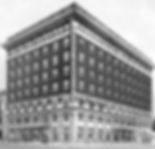
The Harding Hotel
Ground was broken at 267 West Center Street in May of 1922 for what would become the finest hotel in Marion. A Marion Steam Shovel dug the first scoop. By February of 1924, the hotel—built at a final cost of $900,000—was ready for patrons. The colonial-style structure was designed to be “fire-proof,” utilizing reinforced concrete construction with a limestone and brick exterior. Partitions of hollow tile throughout the eight-story building rendered it “sound, moisture, and vibration proof.” The entire cost of construction was raised locally. Although completed in 1924, President Harding did not live to see the finished hotel.